
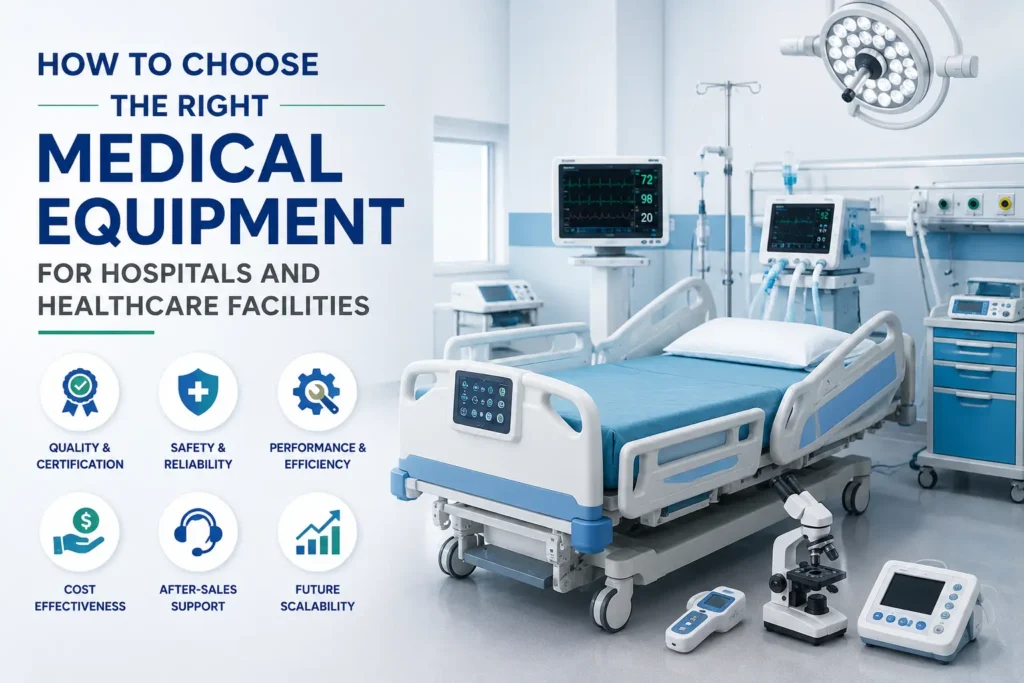
Selecting the right medical equipment is one of the most important decisions for hospitals, clinics, diagnostic centers, and healthcare facilities. High-quality medical equipment not only improves patient care but also enhances operational efficiency, ensures safety, and helps healthcare professionals deliver accurate diagnoses and effective treatments.
With countless options available in the market, choosing the right equipment can be challenging. Factors such as quality, certifications, technology, maintenance, and budget all play a significant role in making the right investment.
In this guide, we’ll discuss the key factors to consider when purchasing medical equipment and how to make informed decisions that benefit both healthcare providers and patients.
Why Choosing the Right Medical Equipment Matters
Medical equipment is the backbone of every healthcare facility. From basic examination tools to advanced diagnostic machines, every piece of equipment contributes to patient care.
Choosing reliable equipment helps:
- Improve patient safety
- Increase diagnostic accuracy
- Enhance treatment outcomes
- Reduce equipment downtime
- Improve workflow efficiency
- Ensure compliance with healthcare regulations
Poor-quality equipment may lead to inaccurate results, delayed treatments, and higher maintenance costs.
Understand Your Healthcare Facility’s Requirements
Before purchasing any equipment, evaluate the specific needs of your facility.
Consider:
- Type of healthcare facility
- Number of patients served daily
- Medical specialties offered
- Available installation space
- Staff training requirements
- Future expansion plans
For example, a multi-specialty hospital will require more advanced equipment than a small outpatient clinic.
Prioritize Quality Over Price
While budget is always important, medical equipment should never be selected solely based on price.
High-quality equipment offers:
- Longer lifespan
- Better performance
- Greater reliability
- Lower maintenance costs
- Higher patient safety
Investing in premium products reduces replacement costs and improves long-term value.
Check Certifications and Industry Standards
Always purchase equipment that complies with recognized quality standards.
Look for certifications such as:
- ISO Certification
- CE Marking
- FDA Approval (where applicable)
- BIS Certification
- GMP Standards
Certified products undergo rigorous testing to ensure safety, quality, and performance.
Evaluate Technology and Features
Modern medical equipment comes with advanced features that improve efficiency and accuracy.
Important features include:
- Digital displays
- Touchscreen interfaces
- Wireless connectivity
- Automatic calibration
- Data storage
- Easy integration with hospital systems
Choose equipment that simplifies workflows while maintaining accuracy.
Consider Ease of Use
Healthcare professionals work in fast-paced environments where efficiency matters.
Equipment should offer:
- User-friendly controls
- Clear displays
- Quick operation
- Easy cleaning
- Minimal training requirements
Simple and intuitive equipment reduces errors and improves productivity.
Ensure Easy Maintenance and Service Support
Medical equipment requires regular maintenance to maintain peak performance.
Before purchasing, check:
- Warranty coverage
- Availability of spare parts
- Local service support
- Preventive maintenance options
- Technical assistance
Reliable after-sales support helps reduce downtime and extends equipment life.
Assess Product Durability
Hospitals and healthcare facilities operate continuously.
Medical equipment should be built using durable materials capable of withstanding frequent use.
Look for:
- Corrosion-resistant materials
- High-quality stainless steel
- Medical-grade plastics
- Heavy-duty construction
- Easy-to-clean surfaces
Durable equipment provides better value over time.
Essential Medical Equipment Every Healthcare Facility Needs
Depending on the facility type, commonly required medical equipment includes:
Diagnostic Equipment
- Blood Pressure Monitors
- Thermometers
- Pulse Oximeters
- Stethoscopes
- ECG Machines
Patient Care Equipment
- Hospital Beds
- Wheelchairs
- Stretchers
- Examination Tables
- Patient Monitors
Laboratory Equipment
- Microscopes
- Centrifuges
- Laboratory Instruments
- Sample Storage Equipment
Emergency Equipment
- First Aid Kits
- Oxygen Cylinders
- Suction Machines
- Defibrillators
- Emergency Stretchers
Surgical Equipment
- Surgical Instruments
- Sterilization Equipment
- Surgical Lights
- Operating Tables
Consider Infection Control and Hygiene
Infection prevention is a critical aspect of healthcare.
Choose equipment made from materials that:
- Resist bacterial growth
- Are easy to disinfect
- Withstand frequent sterilization
- Meet infection control standards
Disposable medical products also help minimize cross-contamination.
Buy from a Trusted Medical Equipment Supplier
Working with a reputable supplier ensures:
- Genuine products
- Certified equipment
- Competitive pricing
- Timely delivery
- Technical support
- Product warranty
An experienced supplier can also recommend the most suitable products for your facility.
Questions to Ask Before Purchasing
Before finalizing your purchase, ask:
- Is the equipment certified?
- Does it meet industry standards?
- What warranty is included?
- Are spare parts readily available?
- Is technical support available?
- How often is maintenance required?
- Is staff training provided?
- Can the equipment be upgraded in the future?
These questions help avoid costly mistakes.
Common Mistakes to Avoid
Many buyers make purchasing decisions based only on price.
Avoid these common mistakes:
- Buying uncertified products
- Ignoring maintenance requirements
- Choosing equipment without warranty
- Overlooking service availability
- Purchasing unsuitable equipment
- Not considering future scalability
Proper planning saves money and improves operational efficiency.
Why Choose Shakti Surgical?
Shakti Surgical is committed to providing high-quality medical, surgical, laboratory, hospital, and healthcare products that meet industry standards.
Our product range includes:
- Medical Equipment
- Surgical Products
- Hospital Furniture
- Laboratory Equipment
- Clean Room Products
- Disposable Medical Products
- Healthcare Supplies
With a focus on quality, reliability, and customer satisfaction, we strive to support hospitals, clinics, laboratories, and healthcare professionals with dependable solutions.